
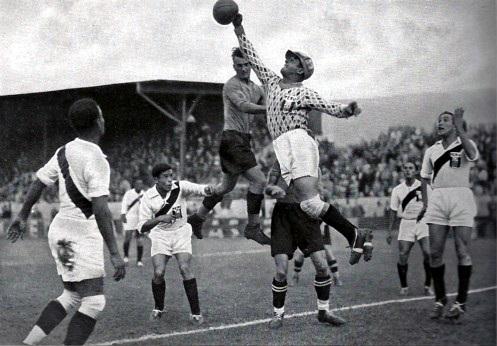
In the summer of 1936, forty Peruvian athletes arrived in Adolf Hitler’s Berlin to compete in the Summer Olympics for the very first time. They would end up leaving early and empty handed, and return to a heroes’ welcome back home.
In order to get to Germany, the team had spent 44 days at sea, opting to make the cross-Atlantic voyage by boat– a far cheaper alternative to air travel at the time. They had struggled to raise the 100,000 soles (equivalent to approximately $30k USD, now more than $700k) necessary to even attend the games.
The decision to hold the Olympics in Germany was a controversial one, even at the time. The American delegation came close to boycotting, though these efforts were stopped by US Olympic Commissioner Avery Brundage. Boycott movements did not manage to pick up steam amongst Latin American countries.
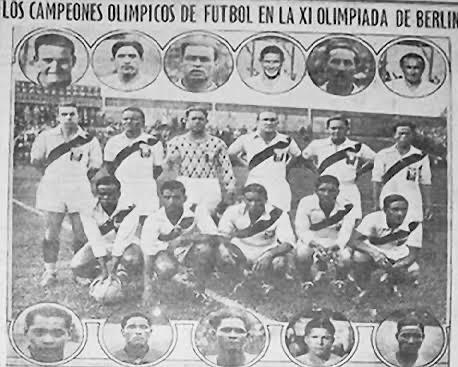
The Peruvian delegation consisted of competitors in athletics, basketball, cycling, diving, swimming, shooting and soccer. The 1930s were considered the golden age of Peruvian soccer. Nearly a century later, Peruvians still regard Alejandro “La Mangera” Villanueva and Teodoro “Lolo” Fernandez as some of the finest Peruvians to grace the pitch.
Their forwards were particularly elite, many of them playing for Club Alianza Lima. They were given the nickname rodillo negro– the black steamroller– a reference to both their offensive dominance and the color of the players’ skin. The Olympic squad consisted of players of Indigenous, African and European descent. Many of them were working class and illiterate. By any definition, this group was an affront to the Nazi ideology.
Despite having spent six weeks at sea, the Peruvian team displayed their greatness on the world stage with a decisive seven to three victory against Finland. The light of the Olympic torch was not too bright for Peru’s stars, with Fernandez and Villanueva scoring five and two goals, respectively.
Their next opponent, Austria, proved to be more challenging. The European nation was in a golden era of their own, nicknamed the Wunderteam, though most of the competitors in the 1936 games were unknown amateurs.
Austria dominated the first half, scoring two goals while keeping Peru scoreless. It wasn’t until the 75th minute when a goal from Jorge Alcalde cut Austria’s lead in half. Six minutes later, Villanueva scored the final goal of regulation time, tying the score and sending the game to extra time. As Peru gained momentum, Austrian fans heckled the players, telling them to “get out of Europe.” The European media couldn’t hold back their disdain towards Peruvian people, writing about the “savage action of the Peruvians” and remarking that the “the negroes in their ranks commit some unqualified nasty tricks.”
Peru carried their energy into extra time. Villanueva and Fernandez scored one goal each. When the final whistle was blown, the score was 4-2. The comeback was complete– in their first Olympic appearance, Peru made the semi-finals. Peruvian fans in Berlin rushed on to the field in celebration.
Again, the European media was appalled by the actions of Peruvian fans and players, with one newspaper writing, “Fanatics forced their way onto the field and kissed the players… We civilised central Europeans felt sorry for the players!”
Austrian football president Dr. Richard Eberstaller later claimed that fans and players were violent and armed, causing injury to Austrian players. Even though there were photographers at the event, no pictures of these altercations have ever been located. Austria challenged the results of the match to the FIFA and International Olympic Committee.
The following day, FIFA and the IOC convened a meeting with both teams to litigate the issue. Peru was unable to make the meeting, allegedly due to traffic delays caused by either Nazi parade or a cycling race. Without any Peruvian representatives, the FIFA and IOC ruled in Austria’s favor. A closed door rematch was scheduled.
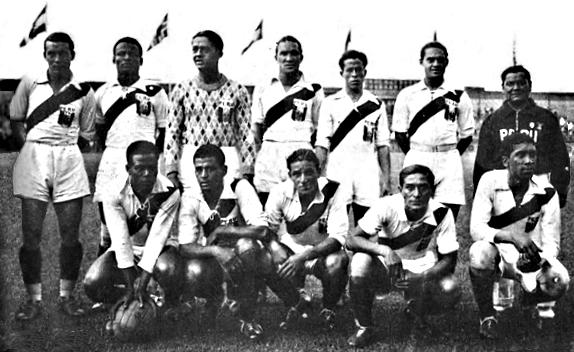
The Dignity of Peru
When match day arrived, “hundreds of armed SA men” were posted at the stadium in anticipation of the “frightful Peruvians.” The enhanced security was unnecessary. Peru’s team did not show, in defiance of FIFA and the IOC’s ruling.
In response to Peru’s actions, the Austrian media said, “The Peruvians with their negro dances, with their savagery and their battle songs got on our nerves enough, but that is now over.”
Despite the strife they had endured just to get to Berlin, the entire Peruvian delegation withdrew from the Olympics. By that time, most Peruvian athletes had been eliminated, but the Olympic journeys of Peru’s basketball team and swimmer Walter Ledgard came to an abrupt end.
Other Latin American countries criticized the decision, with Argentina, Uruguay, Chile and Mexico issuing statements in support of Peru. Colombia took their solidarity a step further and withdrew along with the Peruvians, though all of their competitors had been eliminated by then.
When news of the decision reached Lima, the public was on the second day of city-wide celebrations of their victory over Austria. The party quickly turned into a riot, with 20,000 fans showing up at Plaza Mayor to express their anger. They threw stones at the Germany and Austrian embassies. In the port city of Callao, dockworkers refused to unload German cargo ships. Similar protests took place across the nation.
Peru’s protest and withdrawal made waves in the Olympic Village. When Chinese boxer Jin Guidi defeated British Dick Shrimpton, the Brits also opted to challenge the decision. Again, the IOC sided with the European nation, declaring Shrimpton the winner of the match.
China decided not to protest and received praise from the Western media. In Illustrated Week-End Sporting World, a reporter wrote, “the entire Chinese delegation chose the course of honor.” For some Chinese fans, this decision was not so honorable. “China is always being bullied, and our tolerance is even greater than that of the Peruvians,” remarked one Chinese writer.
Peru left Germany the same way they arrived: by boat. As the 1936 Summer Olympics came to a close, Peru embarked on another pilgrimage across the sea. The Wunderteam defeated Poland 3-1 to advance to the finals, where they’d lose 2-1 to Benito Mussolini’s Italy, winning the silver medal.
Retaining most of their Olympic roster, Peru would go on to win both the 1938 Bolivarian Games and the 1939 South American Championship. Austria, on the other hand, would have their sports disrupted by Hitler’s government. Though they qualified for the 1938 World Cup, they were forced to withdraw when Germany annexed Austria. Three members of Austria’s 1936 Olympic squad, Ernst Künz, Karl Wahlmüller and Walter Werginz, would be killed in action while fighting for Germany in World War II.

The First to Defeat the Nazis
In the decades that followed, the 1936 Peruvian Olympic team became inseparable from the narratives that pervaded the post-war period. The Peruvian public still very much believes that the Nazis robbed their team of an Olympic medal because of their race. Over the years, some have even come to believe that Austrian-born Hitler himself made the call to overturn the results. The event has reached near mythology– a legend that long before the Red Army took Berlin, a group of Peruvian mestizos handed Hitler his first loss on his home turf.
The reality is more complicated. First, there is no evidence that Hitler attended the game. None of the official records or statements from FIFA or the IOC mention race as a factor in their decision making, though this can be attributed to wanting to keep up appearances rather than actual intent. Then again, the European media’s reactions to Peru’s victory makes it hard to believe that racism would not play a role in their ruling.
Though then-Peruvian president Oscar Benavides was lauded for his decision to recall the Olympic delegation, he was himself an authoritarian. Benavides’s government was initially critical of the “crafty Berlin decision,” but once the public directed their rage at the German and Austrian governments, Benavides became concerned that this would damage the diplomatic relationship between Peru and Germany.
Peruvian IOC member Alfredo Benavides (no relation to the president) stated that “that no single German position had anything to do with the matter” of the overturned results. He went on to state that the protests outside of Germany embassies in Peru were, “conducted by Communists… we see in today’s Germany the decisive power against Communism.”
The 2026 World Cup: Will History Repeat Itself?
Still, the 1936 Peruvian Olympic soccer team holds a well-deserved place in the country’s history, regardless of the ongoing politics or the precise reasons behind the disavowal of their victory.
In their first two Olympic games, they demonstrated their ability to overcome great adversity before the eyes of the world. Even now, marginalized people are expected to be grateful to even be invited to elite western spaces. Yet, in hostile territory and under high stakes, the Peruvians chose dignity over Olympic glory.
Nearly 90 years later, the world found itself similarly situated as the United States, led by President Donald Trump, was one of three countries hosting the 2026 FIFA World Cup. Before the competition started, there was great concern about how the ongoing violence and raids by Immigrations and Customs Enforcement (ICE) would impact fans, players, staff and media looking to attend the games.
Unsurprisingly, the Department of Homeland Security has made their influence known at this year’s World Cup. Omar Abdulkadir, who was set to be the first Somali referee to officiate a World Cup game, was denied entry to the United States. According to a Customs and Border Patrol official, Abdulkadir’s entry was denied due to “derogatory information, including association with suspected members of terror organizations.”
Another notable absence was that of Michel Kuka Mboladinga, better known as “Lumumba Vea.” Hailing from the Democratic Republic of the Congo, Mboladinga has attended DRC soccer matches since 2013, during which he stands motionless with his right arm raised. He does this as a tribute to Patrice Lumumba, the first president of the DRC after it declared independence from Belgium. Six months after taking office, Lumumba was tortured and murdered by a Belgian-backed coup. He remains an iconic figure in anti-colonial movements around the world.
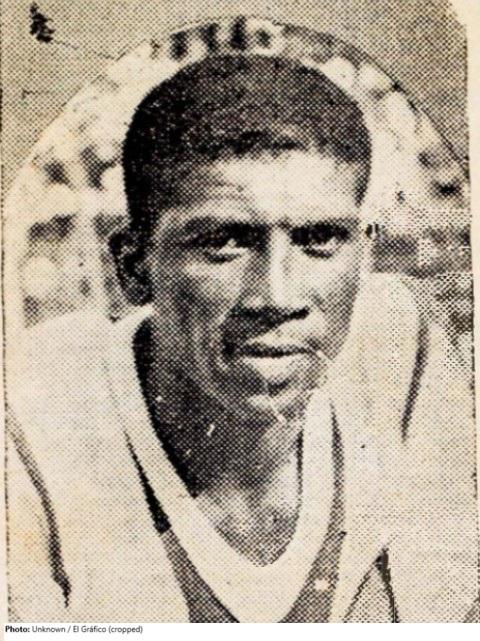
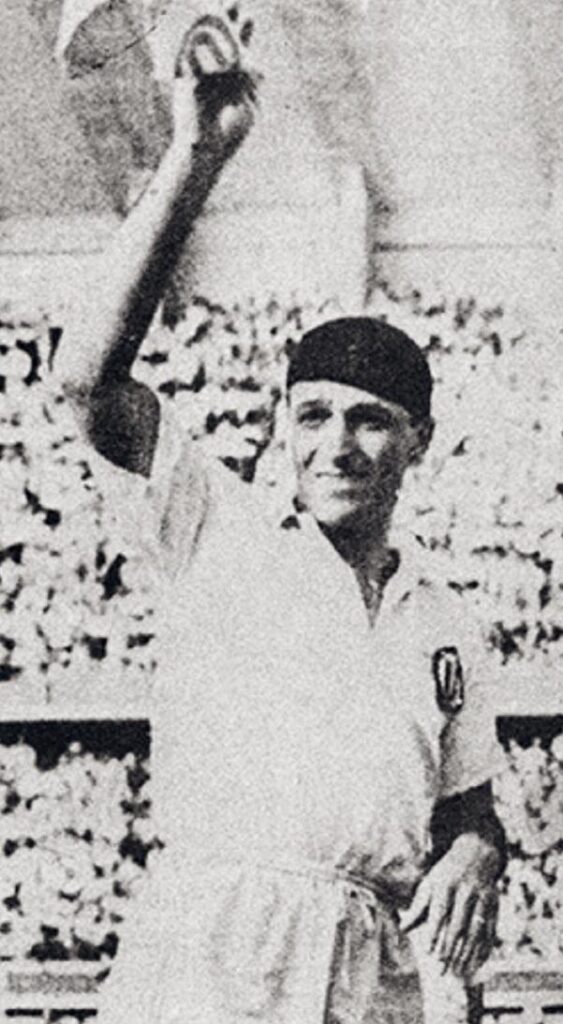
Mboladinga was denied entry to the US, despite being an official member of the Congolese team’s delegation and missed his country’s first ever goal in the World Cup.
Most notable has been the treatment of the Iranian national team, who had to compete while their nation was being attacked by the United States and Israel. Many members of their staff were denied US visas, leading the team to set up base in Tijuana, despite all of their group stage matches taking place in the States. Their World Cup journey ended in the group stages after a game winning goal against Egypt was controversially disavowed by the referee.
On the denial of Iranian team members’ visas, a US State Department representative told ESPN, “We will not allow the Iranian team to abuse this system to sneak terrorists into the United States under false pretenses.”
Though Peruvians will likely never know if Hitler, or some other Nazi official, made the call to overturn their victory, we are certain that Trump intervened to benefit his home team. American player Jordan Balogun was issued a red card during his team’s victory in the first knockout round, disqualifying him from participating in the next match. After Trump contacted FIFA Commissioner Gianni Infantino, the call was overturned. Balogun was allowed to play against Belgium, where the home team lost 4-1.
Outside of Peru, few know the story of the 1936 Peruvian Olympic team. Though what they experienced is certainly an injustice, it pales in comparison to the atrocities committed by Hitler’s Germany. Still, it is an artifact of its time– a paragraph in the volumes of evidence of the extent of the depravity of Nazi rule.
When we remember the Berlin Olympics, we don’t think of the games, the records and the medals. We recall that the global athletic community played games on the same soil where families were torn apart and concentration camps were filled with people labeled dissidents and criminals by their government.
As to how the 2026 World Cup will fare in comparison to the doings of the Trump administration, only time will tell.